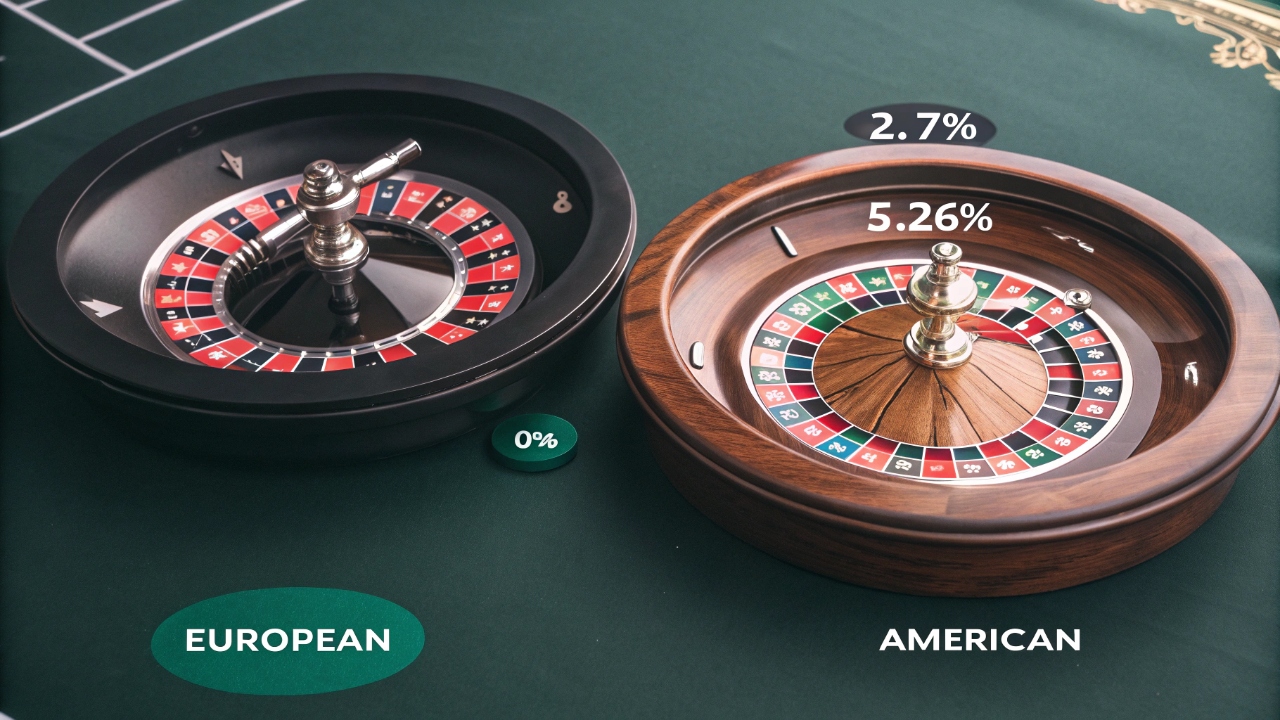
Roulette seems like a simple game: a ball, a wheel, bets, and an instant result. But behind that simplicity lies a key detail that directly affects a player’s money over time. The detail is the wheel type. European and American roulette differ not only in table layout but also in probability math. And that math determines how quickly a bankroll loses stability and how much advantage the casino gains in each session.
Why One Extra Number Changes the Entire Game
The core difference between the two roulette versions is the number of pockets on the wheel. The European wheel has 37 pockets: numbers 1 to 36 and a single zero. The American wheel has 38: it adds a double-zero pocket. At first glance, the difference seems minor, but in probability terms it is a serious shift that changes real winning chances on every bet type.
When a player bets on a single number, for example, the payout in both versions is usually the same — 35 to 1. However, the probability of winning is different: in European roulette it is 1 in 37, while in American roulette it is 1 in 38. The casino pays the same amount, but winning events occur less often in the American format. That is exactly how the additional house advantage is created — easy to miss in short sessions, but very noticeable over the long run.
Rule and Betting Differences: Where Intuition Fails
Players often assume that red/black or odd/even bets are close to a fair 50/50 chance. In reality, zero and double zero make these bets mathematically asymmetric. In the European version, the win probability on even-money outside bets is slightly below half because of the single zero. In the American version, it is even lower because there are two green pockets.
In some European casinos, there is a rule that returns part of the stake when zero lands on even-money bets. The rule can have different names, but the idea is the same: the player does not lose the full amount and may lose only half, or receives a re-spin under certain conditions. This significantly reduces the house edge and makes the European format even more favorable for disciplined play. In American roulette, such softening rules are much less common, so the mathematical pressure on the bankroll is higher.
The Casino’s Mathematical Edge: Dry Numbers, No Illusions
Strictly speaking, the house edge in European roulette is about 2.7%, while in American roulette it is about 5.26%. These are not abstract percentages — they represent the player’s long-term expected loss per betting turnover. With the same playing style and the same budget, the American version statistically drains funds almost twice as fast.
It is important to understand that short sessions can produce any outcome: profit, drawdown, or uneven swings. But over a long sample, the law of large numbers takes over, and actual results move closer to mathematical expectation. That is why talk about a “lucky table” is usually emotional perception rather than probabilistic reality. The wheel does not remember previous spins, and each new spin is an independent event.
Which Version Is More Rational for a Player
If the goal is to extend playtime and reduce expected losses, European roulette is objectively the better choice. One zero instead of two already creates softer math, and the presence of zero-protection rules in some venues further improves the player’s position. The American version is often chosen because of habit, atmosphere, or availability in a specific casino, but from a calculation standpoint it is less favorable.
A rational roulette approach is built not on “secret systems,” but on risk control, stake sizing, and understanding probabilities. No progression system can cancel the house edge; it only redistributes volatility over time. So the player’s best tool is not trying to outsmart the wheel, but choosing better game conditions. In this comparison, European roulette almost always beats American roulette in the key metric: the cost of each mistake over distance.